A Texas home inspection is not about finding a perfect house. It is about understanding the one you are buying. Here is how the inspection, option period, additional evaluations, and inspection report fit together.
You found the house. Negotiated the contract. Signed everything.
Then comes the inspection.
This is the point where a buyer can go from admiring the kitchen and imagining furniture placement to reading about drainage, flashing, GFCIs, water heaters, attic ventilation and something labeled "Deficient" in bold type.
That change of perspective is actually useful.
A home inspection is where we stop looking at a house primarily as a buyer and start learning how it works as a property.
The report may be long. There may be photographs, arrows, comments and items you have never thought about before. None of that automatically means you picked the wrong house.
I tell buyers this before the inspection:
We are not looking for a perfect home. We are trying to understand the home well enough to make a good decision about buying it.
That is a very different goal.
In Texas, the inspection usually starts with the option period
In many Texas transactions, the buyer and seller negotiate an option period as part of the contract.
This is commonly when buyers conduct inspections and, when appropriate, obtain additional evaluations.
The Texas Real Estate Commission notes that the termination option is negotiable and that a buyer with the contractual termination right can use the option period to inspect the property and negotiate an amendment concerning repairs. (TREC)
This is why I pay close attention to the calendar once a contract is effective.
An option period can move quickly.
The general inspection may raise a question that needs a second look from a roofer, plumber, electrician, structural engineer, HVAC contractor, pool professional, pest professional or another specialist. If we wait until the end of the option period to start asking those questions, we have made the process harder than it needs to be.
So I prefer to get the general inspection scheduled promptly and leave ourselves time to understand what it tells us.
The exact rights, deadlines and obligations come from the contract, so buyers should rely on their specific contract and appropriate professional guidance rather than a general article.
What is the home inspector actually doing?
Texas inspectors licensed by TREC work under state Standards of Practice.
TREC describes the inspection as a limited visual survey and basic performance evaluation of the home's systems and components. It is designed to tell you about the general condition of the residence at the time of inspection. It is not a destructive investigation into everything hidden inside walls, underground or beneath finished surfaces. (TREC)
That distinction is important.
An inspector can tell us, "I see something here that isn't performing as expected."
That does not always mean the inspector can tell us why it happened, how extensive it is, what it will cost to correct, or what will happen five years from now.
Sometimes the right answer is simply:
We need another set of eyes on this.
What gets looked at?
A standard Texas inspection covers a lot of ground.
Depending on the home and what is accessible, the inspector evaluates required components of structural systems, electrical systems, heating and cooling, plumbing, appliances and other systems included in TREC's Standards of Practice. (TREC)
In everyday buyer language, that means we are looking at things such as:
the foundation and visible structural components
grading and drainage
roof covering materials and accessible attic areas
exterior walls, doors and windows
electrical panels, wiring and required electrical components
heating and air-conditioning equipment
plumbing fixtures, water heaters and visible plumbing components
built-in appliances covered by the inspection standards
The purpose is not to dismantle the house.
It is to get a professional, independent look at how the accessible parts of the house are performing on that day.
Then the report arrives
This is the moment when perspective matters.
A 60-page report does not necessarily describe a worse house than a 30-page report.
Photos take space. Explanations take space. Inspectors document what they observe.
And in Texas, the word "Deficient" has an actual meaning within the TREC Standards of Practice. A deficiency is a condition that, in the inspector's reasonable judgment, materially affects the performance of a system or component or constitutes a hazard specified by the standards. (TREC)
That means we should take deficient items seriously.
It does not mean every deficient item has the same significance.
A missing electrical safety device, a nonperforming HVAC component, a drainage concern and a roof issue can all appear in a report. They are not automatically equivalent in cost, urgency or effect on your decision.
Instead of counting red marks, I prefer to sort the report into questions:
What is the issue?
How important is it?
Do we understand it well enough?
Does another professional need to look at it?
Does it affect what you are willing to buy, repair, maintain or negotiate?
That keeps the report in perspective.
The general inspection may not be the end of the investigation
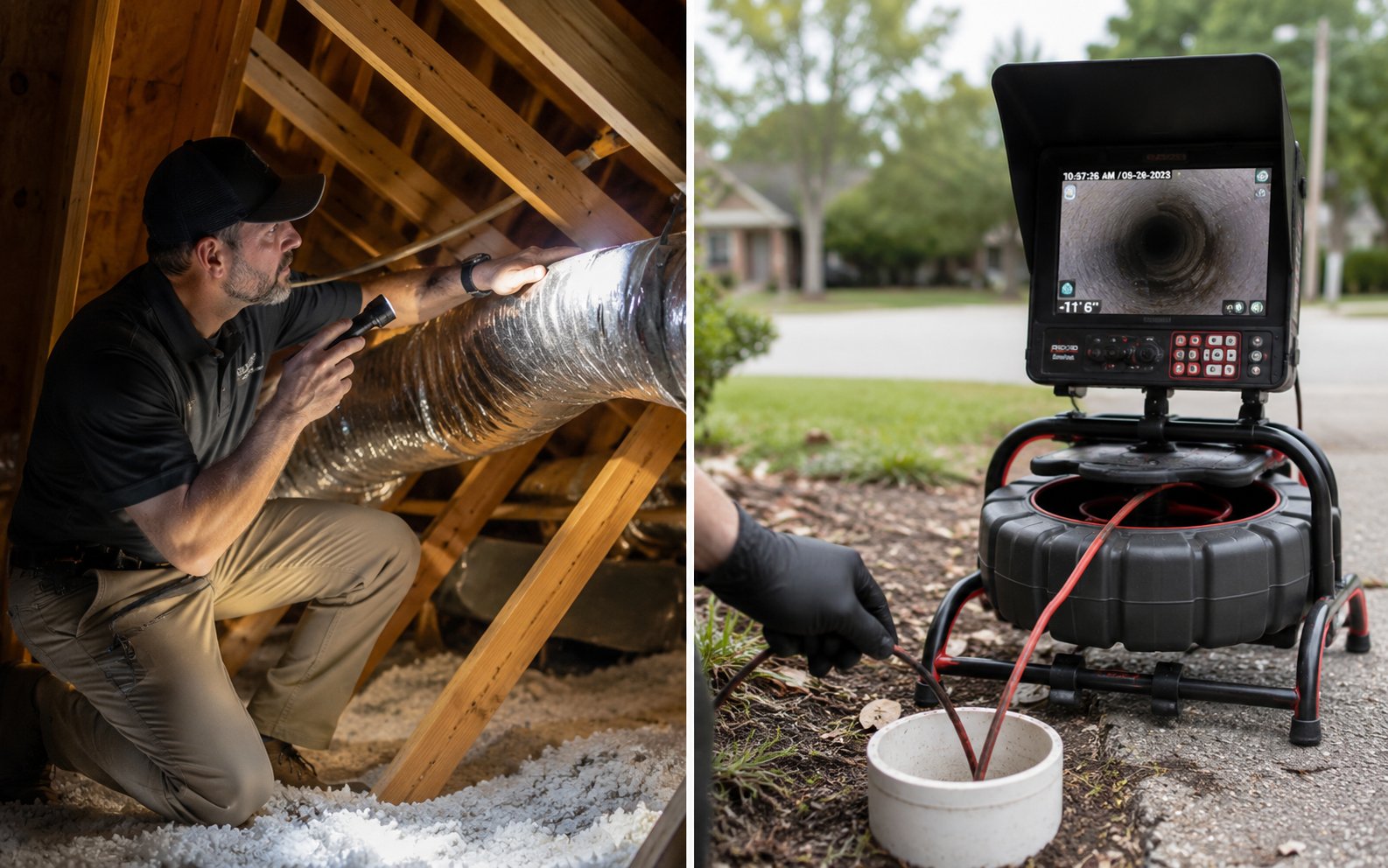
This is one of the most useful things for a Texas buyer to understand.
A general home inspection is broad.
It is not necessarily the only evaluation we will consider.
Some properties have systems or conditions where a separate inspection, optional inspection service, or specialist evaluation can give us better information.
The house should help determine where we look next.
WDI inspection
A general TREC real estate inspection does not determine the presence or absence of termites or other wood-destroying insects. (TREC)
That is where a Wood Destroying Insect inspection, usually called a WDI inspection, comes in.
Texas regulates WDI inspections separately through the Texas Department of Agriculture. The state's official WDI report addresses visible evidence of wood-destroying insects and conditions conducive to infestation. The inspection itself is limited to visible and accessible portions of the structure. (Texas Agriculture)
Buyers often casually call this the "termite inspection," but WDI is the more accurate term.
The important point is that it is separate from the standard home inspection.
If evidence or conducive conditions are reported, we find out what they mean rather than immediately jumping to conclusions.
Sewer scope
The plumbing portion of a general inspection does not mean someone has run a camera through the underground sewer line.
In fact, TREC's current Standards of Practice specifically say that cameras or other tools used to inspect the interior of a drain or sewer line are specialized equipment not required as part of the standard inspection. (TREC)
A sewer scope can give us a view inside an accessible portion of the line that we could not otherwise see.
Depending on the property and available access, it may help identify conditions that deserve further evaluation by a plumber.
I especially want to think about the sewer line when the home's age, plumbing history, prior repairs, inspection observations or other circumstances give us a reason to know more.
It is not about assuming there is a problem.
It is about deciding whether there is something underground that is worth seeing before you own it.
The roof
The roof is different because it is part of the standard Texas home inspection.
Under the current TREC standards, the inspector addresses roof covering materials, identifies the type of covering and inspection vantage point, looks for evidence of water penetration and previous repairs, and reports required deficiencies. (TREC)
There are limits.
An inspector is not required to walk a roof if doing so cannot be done safely or could significantly damage the roof covering. The inspector is also not required to determine the roof's remaining life expectancy or identify latent hail damage. (TREC)
That is one reason a roofing professional may occasionally be the logical next call.
If the general inspection raises a roof question, I would rather clarify it during the option period than spend the rest of the transaction guessing.
A roof may also raise separate insurance questions. Buyers should discuss insurability, coverage and underwriting requirements directly with their insurance professional because those determinations fall outside the home inspection itself. TREC specifically notes that determining insurability is outside the required inspection scope. (TREC)
Pool and spa
If the house has a pool, I want to know whether the inspector is inspecting it and exactly what that inspection includes.
Pools, spas, hot tubs and related equipment fall within TREC's optional systems. An inspector is not required to inspect optional systems unless the inspector agrees to perform that service. (TREC)
When performed under the applicable TREC standards, that inspection can address accessible components such as equipment, visible leaks, certain electrical items and safety barriers. (TREC)
A complicated, older or visibly problematic pool may justify additional evaluation by a qualified pool professional.
Again, the objective is information.
The pool does not need to frighten us. We simply want to understand what comes with it.
Foundation and structure
Foundations tend to get buyers' attention quickly in Texas.
The general inspector does have an important role here. TREC requires the inspector to render a written opinion regarding foundation performance and generally report visible indications used in forming that opinion. (TREC)
But a home inspector is not acting as a structural engineer.
If the observations warrant a more specialized structural analysis, that is when an engineer or another appropriately qualified professional may become part of the conversation.
In Austin, I also pay attention to how the home relates to its site.
Drainage, slope, retaining conditions and the way water moves around a property can matter just as much as what we see inside. This deserves particular attention on homes with significant elevation changes or more complicated lots.
HVAC, electrical, plumbing and other specialists
The same principle applies throughout the house.
If the inspector finds an HVAC system that is not performing properly, an electrician-worthy issue at the panel, an active plumbing concern or another condition that needs diagnosis, we may bring in the appropriate trade professional.
Not every notation needs a specialist.
Not every specialist recommendation means something terrible has been discovered.
Sometimes we just need a better answer.
What about sprinkler systems, septic, wells and other property features?
This is where buyers should look at the actual property, not rely on a one-size-fits-all inspection checklist.
TREC has inspection standards for several optional systems, including landscape irrigation systems, pools and spas, private water wells and private sewage disposal systems. Inspectors are not required to inspect those optional systems unless they agree to do so. (TREC)
A suburban Austin property with a sprinkler system may present one set of questions.
A property farther out with a private well and septic system presents another.
A Northwest Hills home with significant slope, retaining features and an older pool may send us in a completely different direction.
That is why I do not like the idea of simply ordering every inspection available.
Inspect the house you are actually buying.
Should you go to the inspection?
When practical, I think buyers can learn a great deal by meeting the inspector at the property, often toward the end when the inspector can walk through the important observations.
Reading a line in a report is one thing.
Standing in front of the electrical panel, attic access, HVAC system or drainage area while the inspector explains what was observed is another.
It also gives you an opportunity to learn your future home.
Where is the main water shutoff?
Where are the HVAC filters?
What maintenance has the inspector noticed?
Which items deserve attention after closing even if they have nothing to do with negotiations?
An inspection can become part of your owner's manual for the house.
That is often overlooked.
Not everything in the report belongs in a repair request
Once the inspection and any follow-up evaluations are complete, we need to make decisions.
This is where I think buyers benefit from separating information into buckets.
An inspection report is not automatically a repair-request checklist.
Nor is it a scorecard where the home needs to earn a passing grade.
We look at the whole property, the contract, the inspection findings, the buyer's priorities and whatever additional information we have gathered.
Then we decide what matters.
Older Austin homes need context
This is especially important in Austin's established neighborhoods.
A house built decades ago should not be expected to read like a house completed last month.
That does not mean age gets a free pass.
It means we need context.
A remodeled kitchen may be five years old while the plumbing serving it is much older.
The windows may have been replaced but the electrical system may still deserve attention.
A roof may look clean from the street but reveal previous repair work when inspected up close.
A Northwest Hills home on a sloped lot may require us to think carefully about grading and drainage in addition to the foundation itself.
Those are not reasons to avoid established homes.
They are reasons to understand what you are buying.
That same thinking applies to new construction, too. New does not mean there is nothing to inspect. An independent inspection can still provide useful information about the home's condition at that point in construction or before closing.
The inspection should leave you more informed, not more frightened
The best outcome from an inspection is not a blank report.
It is clarity.
Maybe we learn that the items are manageable and you feel even better about moving forward.
Maybe we discover a system that needs attention and gather enough information to discuss it intelligently.
Maybe the property requires another professional to answer a question.
And occasionally, the information materially changes how a buyer feels about the purchase.
That is what the inspection process is supposed to do.
It gives you better information while you still have decisions to make.
The house does not have to be perfect.
You just need to understand the house well enough to decide whether it is the right one for you.
If you are starting your search, my Austin home buying guide explains more of the process before and after the inspection. And if you are comparing established Austin neighborhoods, my neighborhood guides can help you understand how housing stock, lots and property characteristics differ across the city.
Plan Your Austin Home Search
When I represent a buyer, my role is not to tell them that every inspection item is a crisis or that nothing matters.
It is to help keep the information in context, coordinate the right questions and professionals, watch the contractual timeline, and make sure the buyer can make the next decision with their eyes open.
If you are considering buying in Austin and want to talk through the process, Plan Your Austin Home Search.
Frequently Asked Questions
Is a home inspection required in Texas?
A home inspection and the contractual requirements of a purchase are separate questions. Many buyers choose to obtain an independent inspection so they can better understand the property's condition. Buyers should review their particular contract and circumstances with the appropriate professionals.
Is the home inspection usually done during the Texas option period?
Often, yes. TREC specifically notes that a buyer may use an agreed option period to perform an inspection and negotiate an amendment concerning repairs. The option period itself is a negotiable contract term, so the specific contract controls.
Does a Texas home inspection include termites?
No. TREC's general inspection standards do not require the home inspector to determine whether wood-destroying insects are present. A Texas WDI inspection is a separate regulated inspection addressing visible evidence and conducive conditions.
Does the general inspection include a sewer camera?
No. A sewer camera is specialized equipment and is not required under TREC's standard home inspection requirements. A sewer scope may be ordered separately when appropriate for the property.
Is the roof included?
Yes. Roof covering materials are included in the TREC inspection standards, subject to access and safety limitations. The general inspection does not require the inspector to determine remaining roof life or latent hail damage, so a roofing professional may sometimes be useful for additional evaluation.
Is a pool automatically included in a home inspection?
No. Pools, spas and hot tubs are considered optional systems under the TREC Standards of Practice. Confirm with the inspector whether the pool inspection is included or being ordered as an additional service.
Should I inspect a brand-new home?
An independent inspection can still be useful on new construction. New construction has different inspection considerations than a resale home, and the appropriate timing and scope will depend on the stage of construction, builder process and transaction.
This article is provided for general real estate information only. Inspection needs, contractual rights and property conditions vary. Buyers should consult their contract and qualified inspectors, engineers, contractors, insurance professionals, attorneys or other specialists as appropriate.
Albert Allen, REALTOR® | Compass
Updated August 27, 2026