Living Well in Austin | Updated November 2026
By Albert Allen, REALTOR® and Luxury Real Estate Advisor with Compass. Austin native, helping clients buy and sell in Tarrytown, West Lake Hills, Northwest Hills and across Austin.
The Short Answer
Is moving from Dallas to Austin worth it? For many Dallas buyers, yes, if you want hills, water and a smaller metro. Your income tax doesn’t change, the contracts are the same, and a 65+ or disabled school tax ceiling can move with you.
Median home value, Austin metro $482,800 vs. $389,500 in Dallas-Fort Worth (Census, 2024) | Dallas County residents moving to Travis County 2,174 people (IRS, 2022–2023) | Austin core combined tax rate, 2026 $2.1211 per $100; City, County, Central Health, AISD, ACC |
Source: U.S. Census Bureau (2024); IRS migration data (2022–2023); 2026 tax rates set by the City of Austin, Travis County, Central Health, Austin ISD and Austin Community College, added together.
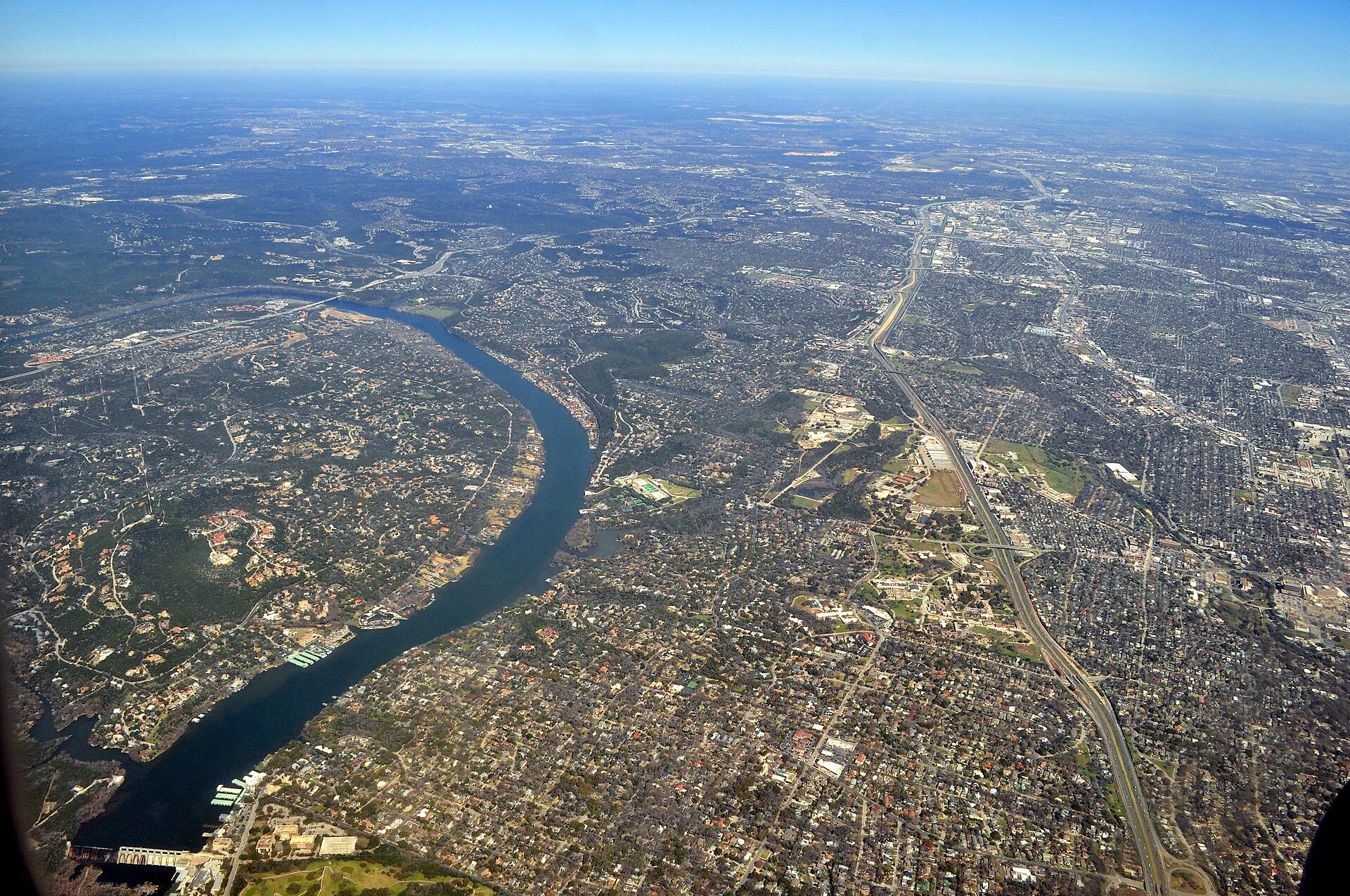
Lake Austin on the Colorado River, with Tarrytown on one side and the hills of West Lake Hills on the other. Photo: Joe Mabel, CC BY 3.0, via Wikimedia Commons.
A move from Dallas to Austin is a Texas-to-Texas move, and that makes it simpler than most. There’s no state income tax on either end, the contract forms are identical, and your homestead exemption works the same way once you file in Travis County.
What changes is the ground under the house, the price of that house, the rules for what can be built next door and the trip back up I-35. Here’s what matters for buying in Austin and selling the home you own in Dallas.
What changes when you move from Dallas to Austin
Income tax: nothing. Texas has no personal income tax, per the Texas Comptroller, so the comparison comes down to home prices, property taxes and insurance.
Property taxes: same system, different units. An appraisal district sets value, and each city, county, school district, hospital district and college district sets a rate. Inside the City of Austin and Austin ISD, the 2026 adopted rates add up to about $2.1211 per $100. Dallas County totals vary by city and school district, so compare against your own Dallas tax statement.
Worked example: a home at the City of Austin’s September 2026 median sale price, $570,958 (Unlock MLS). This assumes the home is your homestead, you’re under 65, it’s valued at the purchase price, and it’s inside the City of Austin and Austin ISD with no extra taxing districts.
Taxing unit (2026 adopted rate) | Taxable value | Rate per $100 | Estimated tax |
|---|---|---|---|
Austin ISD | $570,958 − $140,000 = $430,958 | $0.9184 | $3,958 |
City of Austin | $570,958 | $0.579948 | $3,311 |
Travis County | $570,958 | $0.386210 | $2,205 |
Central Health | $570,958 | $0.132863 | $759 |
Austin Community College | $570,958 | $0.103643 | $592 |
Total | $2.1211 combined | about $10,825 a year |
This is an estimate; confirm with TCAD and the Travis County Tax Office. It leaves out any local-option homestead exemptions the city, county or other units offer, which would lower the bill. At 65+ or disabled, the school exemption rises to $200,000, so the school line becomes $370,958 × $0.9184 ÷ 100 = $3,407.
Homestead: the school exemption is $140,000 statewide. Apply with the Travis Central Appraisal District before May 1 with a Texas ID showing the new address; TCAD says recent buyers can file now for the year they qualify. Starting the next January, the taxable value of your homestead can’t go up more than 10% a year. Remove your Dallas homestead, since you can only claim one.
Over 65 or disabled? Your school tax ceiling can move with you
This is the biggest Texas-to-Texas advantage. If you move to a new home in Texas, you can bring the same percentage of school tax savings with you, according to the Texas Comptroller. It’s the percentage that moves, not the dollar amount.
- Ask the Dallas Central Appraisal District (or Collin, Denton or Tarrant) to remove your exemptions and give you a tax ceiling certificate.
- When you apply for your homestead exemption in Austin, ask to transfer your tax ceiling.
- Only the school tax ceiling moves anywhere in Texas. City, county and college tax ceilings carry over only if you stay in the same city or county.
Albert’s tip: Request the certificate the week you close in Austin. A hypothetical: if your Dallas ceiling meant you paid 60% of the full school tax, the Austin ceiling is set so you pay about 60% of the new school tax. TCAD does the final math.
Who’s already here from Dallas
IRS data for 2022 to 2023 shows Dallas County sent 2,174 people to Travis County. Add Tarrant and Collin counties, and the three together send slightly more households to Austin than Houston’s Harris County, the biggest single source outside the Austin area.
A Dallas-based employer is growing here too. Southwest Airlines announced a pilot and flight attendant crew base at Austin-Bergstrom in December 2025, with about 2,000 jobs expected by mid-2027, according to the Governor’s office.
Hills, limestone and lakes in place of the prairie
Much of Dallas sits on flat Blackland Prairie clay. Austin straddles the Balcones Escarpment: east of I-35 the clay and gentle terrain will look familiar, while west of MoPac you get limestone hills, canyon lots and views.
White Rock Lake gives way to Lady Bird Lake downtown, Lake Austin between the hills and Lake Travis farther west. Lake Austin stays at a fairly constant level, while Lake Travis rises and falls with drought and rain, which matters if you’re buying a dock.
Zoning and Austin’s newer housing rules
Both cities have zoning, but Austin loosened its residential rules. Under the City of Austin’s newer housing rules, most single-family lots can now have up to three homes. Since 2024, a home can be built on a lot as small as 1,800 square feet, down from the old 5,750-square-foot minimum.
For buyers, the lot next door could add units, so check zoning and deed restrictions, which can be stricter than city code. For Austin owners, a larger central lot may appeal to builders as well as owner-occupants.
Neighborhood matches: if you loved it in Dallas, look here in Austin
If you loved… | Look at… | Why it’s a match |
|---|---|---|
Highland Park or University Park | Established close-in streets and mature trees; West Lake Hills adds hills | |
Lakewood | Mid-century homes on generous central lots | |
Preston Hollow | Larger lots and custom homes, with hill views | |
Uptown high-rises | Full-service towers near Lady Bird Lake and the trail | |
The M Streets | Older bungalows on walkable grids |
How buying a home in Texas is different (for you, it isn’t)
What works the same as in Dallas
Buying and selling a home follows the same rules everywhere in Texas:
- Same contracts statewide. Texas real estate license holders must use contract forms written by the Texas Real Estate Commission (TREC). The resale contract you signed in Dallas is the same one used in Austin.
- An attorney is optional. You don’t need an attorney to buy or sell a home in Texas, but you’re always welcome to have one review your contract.
- A title company handles closing. The escrow officer holds the earnest money, coordinates the signing and funding, and records the new deed with the county. The state sets title insurance premiums, so the base premium is the same at any title company.
- Earnest money and option fee. Within three days after the contract is signed, the buyer delivers both to the title company.
- The option period. The option fee buys a set number of days, agreed in the contract, when the buyer can cancel for any reason. This is when inspections and other research happen. If the buyer cancels in time, the seller keeps the option fee, but the buyer gets the earnest money back.
- Seller’s Disclosure. If the buyer receives the Seller’s Disclosure Notice after the contract is signed, the buyer has seven days to cancel.
- Sale prices aren’t public. Texas doesn’t require sale prices to be published, so your agent’s MLS data is the best source for comparable sales.
What’s new in Austin
- A different appraisal district. Your property taxes go through the Travis Central Appraisal District (TCAD) instead of DCAD. Suburban homes fall under Williamson or Hays County’s appraisal district.
- City of Austin rules. Permits and tree protection rules can affect remodels, additions and pools.
- Extra taxing districts. In some areas your tax bill includes a MUD (municipal utility district) or ESD (emergency services district).
The houses themselves
- Foundations: slab-on-grade is the norm in both cities. West-side lots may sit on rock, with retaining walls, steep driveways and drainage to inspect.
- Hail and roofs: ask for the roof’s age and claims history, and price insurance before your option period ends.
- Heat: Austin’s July normal high is 96.6°F against 95.6°F at DFW, with 28.8 days a year at 100°F or more (National Weather Service averages).
- Trees: the City of Austin regulates removal of larger trees, so check before you plan a pool or addition.
Getting back to Dallas
As of June 2026, there are nonstop flights from Austin-Bergstrom (AUS) to DFW on American and to Love Field on Southwest. Check current schedules before you count on a route. By car, it’s I-35 north through Waco, or SH 130 as a toll road on the Austin end.
Flying private? Austin-Bergstrom has private terminals for business jets. Austin Executive Airport in northeast Austin, Georgetown Executive Airport and San Marcos Regional Airport also handle corporate jets, and Lakeway Airpark near Lake Travis serves smaller planes. On the Dallas end, Love Field and Addison Airport are the usual private-jet stops.
Helicopters and helipads. Helicopter charters fly in the Austin area, and some Hill Country estates and ranches have their own landing pads. If a helipad or a home near a runway is on your list, ask Albert and he’ll find homes that fit.
What kind of Austin home fits you?
Before you look at listings, decide how you want to live. Austin has a little of everything:
- High-rise condo. Lock-and-leave living downtown, near Lady Bird Lake, restaurants and music. See downtown condos.
- New construction. Brand-new homes in master-planned communities with pools, trails and builder incentives. Browse new construction.
- Suburban. More house and yard for the money in Round Rock, Cedar Park, Leander and Georgetown, with an easier commute to the north side.
- Central and urban infill. Established neighborhoods like Tarrytown, Allandale and Northwest Hills, plus newer homes built on smaller lots close to downtown.
- Hill Country and lake. Views, acreage or water in West Lake Hills, around Lake Travis or on the waterfront.
- 55+ and downsizing. Single-story homes, lower-maintenance living and 55+ communities.
Not sure yet? Schedule a Walk & Talk and Albert will show you a few of each.
Selling your Dallas home and buying in Austin
Because both sales use the same Texas contracts, the sale and the purchase line up well. Your two agents work from the same paperwork, so timing is mostly a calendar exercise.
- Price the Dallas home first so you know your likely net.
- Choose your order: sell first and rent, buy first with a bridge plan, or make your Austin offer contingent on selling your Dallas home. Ask how Austin sellers are treating contingent offers.
- Ask for a rent-back on the Dallas sale so you can close in Austin and move once.
Albert Allen can connect you with an agent in Dallas through his national relocation network, so both sides of your move work from one plan.
What to verify before you move
- Every tax on the home’s appraisal district record, including any special districts.
- Homestead removal in Dallas, filing in Travis County and, if eligible, the tax ceiling certificate.
- Flood risk, on FEMA’s flood map and the City of Austin’s flood map.
- Zoning, what can be built next door and any HOA or deed restrictions.
- School district: Austin ISD, Eanes ISD, Round Rock ISD, Leander ISD or Lake Travis ISD, among others. Confirm zoning with the district.
Albert Allen’s Perspective on Moving from Dallas to Austin
I think Dallas buyers have the easiest move of anyone coming to Austin. The contracts, the tax system and the climate are familiar, so the decision comes down to house, location and price.
Where I’d spend the most attention is geography. A west-side hillside lot and an east-side clay lot are different houses to own, even at the same price.
If you’re 65 or older, I’d treat the tax ceiling transfer as part of the closing checklist. It’s one of the few benefits that follows you across Texas.
Frequently Asked Questions About Moving from Dallas to Austin
Will my income taxes change if I move from Dallas to Austin?
No. Texas has no personal income tax.
Are Austin homes more expensive than Dallas homes?
On the Census measure, yes: a 2024 median home value of $482,800 in the Austin metro against $389,500 in Dallas-Fort Worth. These are owner estimates, not sale prices.
What is the property tax rate in Austin?
About $2.1211 per $100 for a home in the City of Austin and Austin ISD at 2026 rates, before any special districts.
Can I transfer my over-65 tax freeze from Dallas to Austin?
The school tax ceiling transfers as a percentage of savings. Ask your current appraisal district for a tax ceiling certificate, then include it when you apply for your Austin homestead exemption.
Do I use the same contracts in Austin as in Dallas?
Yes. Texas uses the same state contract forms everywhere.
Is there a direct flight from Austin to Dallas?
Yes. As of June 2026, American flew to DFW and Southwest flew to Love Field.
Which Austin neighborhoods feel like Highland Park?
Tarrytown and West Lake Hills are the usual comparisons for close-in, established streets.
Looking to Sell?
Selling in Dallas first?
Albert Allen can connect you with an agent in Dallas through his national relocation network, so your sale and your Austin purchase are planned together. If you already own in Austin, Albert will also prepare a complimentary home valuation.
About Albert Allen
Albert Allen is an Austin native and Luxury Real Estate Advisor with Compass. He is a Certified Luxury Home Marketing Specialist™ and a member of the Million Dollar Guild™, serves as 2026 Board President of Rebuilding Together Austin and is part of the 2026 Advisory Group for the Austin Board of REALTORS® Foundation.
Albert represents buyers and sellers across Austin, including Tarrytown, West Lake Hills, Barton Creek, Northwest Hills, Allandale, Crestview, Hyde Park and downtown, and helps Dallas buyers plan both sides of a Texas-to-Texas move.
Comparing cities? See how buyers from other cities compare.
Living Well in Austin
Is Austin the Right Fit for You?
Whether you’re weighing Austin neighborhoods, timing a Dallas sale or planning a tax ceiling transfer, Albert Allen is happy to help you understand your options.
Albert will walk you through the neighborhoods, the numbers and the timing that make sense for your move.
Albert Allen | Compass | Living Well in Austin
Schedule a Walk & TalkExplore Austin Neighborhoods
Relocating to Austin · National relocation network · Private listings · Home valuation · Neighborhood guides · Blog
Sources and Methodology
Sources: Texas Comptroller (2023–2026); Travis Central Appraisal District (2026); Bexar Appraisal District; Texas Tax Code; City of Austin (2026 tax rate; HOME amendments); Travis County, Central Health and ACC (2026 rates); Community Impact (Oct. 9, 2026); Unlock MLS (September 2026); U.S. Census Bureau ACS 2024 via Census Reporter; IRS SOI migration data, 2022–2023; Office of the Texas Governor (Dec. 12, 2025); TREC; Texas Department of Insurance; NOAA and National Weather Service 1991–2020 normals; Austin-Bergstrom International Airport (June 2026). Tax figures are estimates. Albert Allen, REALTOR®, Compass RE Texas, LLC. Information is believed reliable but not guaranteed.