If you live in a downtown Austin condo and you've ever tried to walk from Rainey Street to Lady Bird Lake without a car, you know the two blocks that used to ruin the trip. You'd hit Cesar Chavez Street, wait for a gap in traffic, cross, then do it again a block later at Red River. Add a construction fence or two, and what should have been a five-minute stroll to the water turned into a stop-and-go slog past a creek you couldn't actually get close to.
That gap closed on June 6, 2026. Most people who live within walking distance still haven't noticed.
What Actually Opened
The change is called The Confluence, the second construction phase of Waterloo Greenway's long-running effort to rebuild Waller Creek into a connected park system through downtown. It covers 13 acres between 4th Street and Lady Bird Lake, cost $91.5 million in combined public and private money, and was designed by Michael Van Valkenburgh Associates. Jay-Reese Contractors built it, with delivery oversight from Austin Capital Delivery Services.
Geographically, it sits exactly where downtown's foot traffic already wants to go: at the crossroads of the Rainey Street Historic District, the Austin Convention Center, the Emma S. Barrientos Mexican American Cultural Center, and the Ann and Roy Butler Hike-and-Bike Trail. Before this year, those four destinations were close on a map and annoying in practice. John Rigdon, Waterloo Greenway's chief planning and design officer, put it plainly to KVUE ahead of the opening: "It's just a really hard area to get around before."
Where the Detour Actually Disappeared
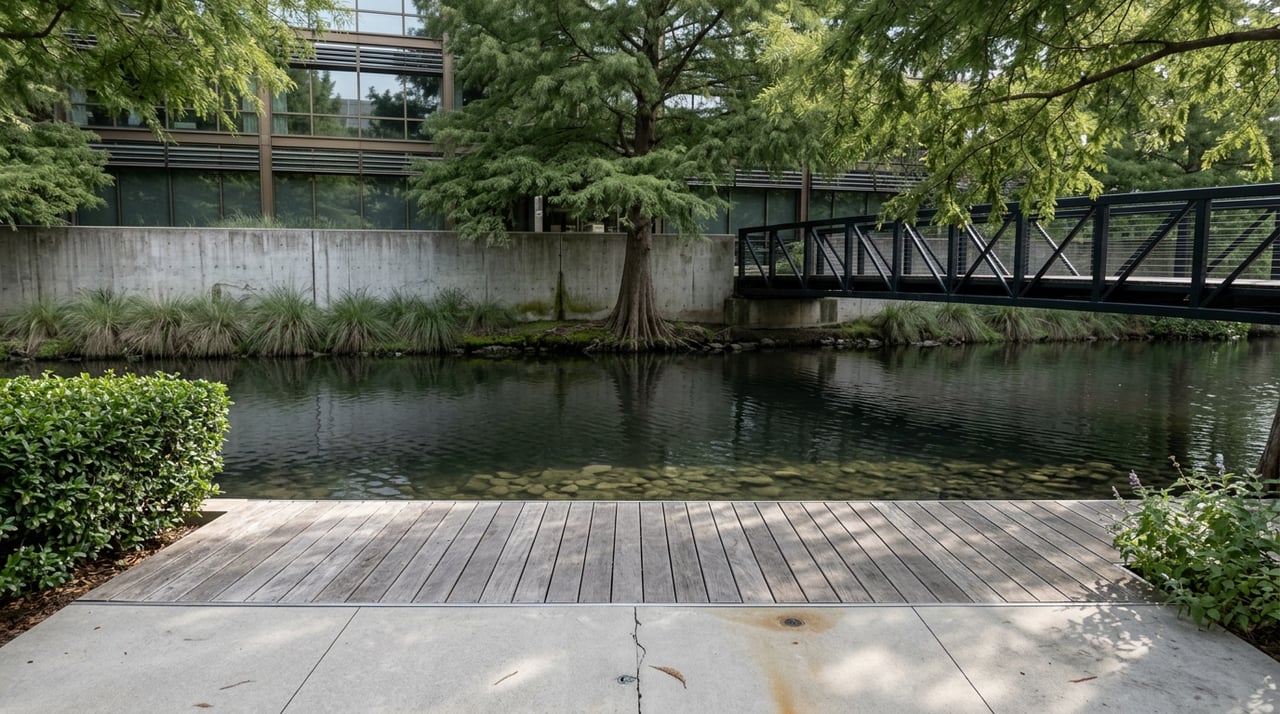
The single most useful thing The Confluence built for a daily walker isn't a lawn or a plaza. It's an 800-foot boardwalk embedded directly into Waller Creek that lets you bypass the intersections at Red River Street and Cesar Chavez Street entirely. Instead of crossing traffic twice, you walk along the water and come out the other side.
Three new lattice pedestrian bridges do the same job in the other direction, giving east-west crossings over the creek that didn't exist before. The first of the three, a 142-foot truss bridge, was installed south of Cesar Chavez Street during construction, ahead of this summer's opening. Combined with the boardwalk, the practical result is a continuous off-street path linking the Lance Armstrong Bikeway, Palm Park, Rainey Street, and the Butler Trail without a single street crossing between them.
The new landmarks along that path give the walk somewhere to go:
- Cypress Grove and Trailhead Plaza, the entry point where the corridor meets 4th Street
- Lakeview Terrace and Explorers Garden, shaded, family-oriented rest stops midway down
- Lagoon Overlook and Leaf Deck, the pair of gathering spaces closest to Lady Bird Lake
None of this existed in any usable form as recently as this spring. If your mental map of downtown still has a dead zone between the convention center and the lake, it's out of date by about three months.
The Part Under the Boardwalk That Matters More Than It Looks
The most technically interesting piece of The Confluence isn't visible from the path. Beneath the new plantings sits downtown's first biofiltration pond, a piece of green infrastructure that treats 26.2 acres of urban stormwater before it reaches the creek. It was completed in October 2025 with support from the U.S. Army Corps of Engineers, which put $11 million toward the project, the first federal dollars the Waterloo Greenway effort had received and the first environmental infrastructure project approved in Texas under Section 5138 of the Water Resources Development Act.
For a walker, the payoff is simple: less trash and runoff sitting in the creek after a downtown storm, which is exactly the kind of thing that used to make this stretch smell bad and look worse for days afterward. The project also added roughly 1,600 new trees and 200,000 native plants across the 13 acres, which is why the corridor already reads as established rather than freshly planted, even though the ribbon was cut just three months ago, in June.
What's Still Ahead, and What Isn't Yet
The Confluence is not the finish line. Waterloo Greenway's next target is Sir Swante Palm Neighborhood Park at 200 N. IH-35, with construction expected to start in 2027, followed by a Phase III segment running from 4th Street up to 12th Street. Once both are done, the full corridor will run 1.5 miles from Waterloo Park down to Lady Bird Lake, 35 acres of connected green space in total. Until then, the trail's northern edge stops at 4th Street. If you're planning a walk that continues north toward Waterloo Park and Moody Amphitheater, which opened back in August 2021 as Phase I, you'll still be back on city sidewalks for that stretch.
Creek Show Is Moving Here, and It's Never Been Here Before
For a decade, Waterloo Greenway's signature fall event, Creek Show, lit up a different stretch of Waller Creek further north with temporary architectural installations built by local designers. This year, for the first time, it relocates to The Confluence, running nightly from November 13 to 21, 2026, in partnership with AIA Austin.
Ten installations are planned. A piece called Contact, from BRR Architecture, uses touch-activated sculptures that change color when visitors interact with them. Fractal Time Fish: Portals of the Confluence, by the design team WarrPaint, suspends welded-steel fish wrapped in crinkled dichroic film that shimmer in daylight and glow under LEDs and lasers after dark. HKS Architects and DPR Construction are building Moon Tower 15.1, a disco-ball-shaped structure that nods to Austin's historic moon towers and sits less than a block from the original Moon Tower 15.
The practical point for a downtown resident: this will be the first time thousands of people test the new boardwalk and bridges at once, at night, in November. If you want to know the terrain before it's crowded, the ten weeks between now and mid-November are the window to do it.
A Route Worth Trying This Week
The easiest way to see the change for yourself is to start at Rainey Street, cut through to the boardwalk near Cesar Chavez, and follow it straight through to Lagoon Overlook at the lake. It's a walk that used to require two street crossings and a detour around construction fencing. Now it doesn't. Whether you're headed to the cultural center for an event or just extending an evening run past your usual turnaround point, this is the version of downtown that exists now, not the one from last year's map.
If you're weighing what a home near this corridor is actually worth, or thinking about how a stretch like this changes a building's day-to-day livability, that's a longer conversation. Living Well in Austin works with buyers and sellers across downtown's condo market and can walk you through what's changed on the ground, not just on paper. Schedule a discovery call and get private access to Austin listings.